
“Energy is a real substance underlying matter and form.”
Randolph Stone
What is osteopathy?
Osteopathy is a manual method for diagnosing and treating restricted movement of the connective tissue’s gliding surfaces and tissue tension throughout the body, which are associated with the onset of disease.
Andrew Taylor Still founded osteopathy as a comprehensive (natural) science of healing. He believed that the true healing power lies within the person themselves, and used mechanical forces as well as intellectual and spiritual means to heal a person of any illness, without resorting to medications of any kind. The central principle was that of vital force. Diagnostic and treatment measures were directed at the mechanical obstacles blocking the flow of this vital force, which could originate from either mechanical trauma or stress-inducing habits or outlook on life. The body and the person were viewed as an absolute adaptive-compensatory system, in which any form of pathology was seen as an adaptation to the relevant environmental factors present (at the level of the cell, tissues, organs, organ systems, and the person as a whole). It followed that a holistic treatment of disturbances in the vital forces should lead to an improvement of the cell’s environment, which would in turn normalize its biochemistry. Disease, then, was not itself the diagnostic or therapeutic target — restoring health was, by restoring the vital forces and thereby restoring integration into the larger whole (from the cellular environment to the person’s sociocultural environment) — that was the treatment of disease. Unsuccessful treatment was attributed to an insufficient ability to recognize and treat the obstacles blocking the vital forces. In Still’s view, osteopaths should trust fully in this approach or philosophy and its mechanisms.
How does osteopathic treatment work?
Diagnostic and treatment methods are used to identify and treat changes in the mobility of the connective tissue’s gliding surfaces throughout the body (including nerves and blood vessels), as well as changes in tissue tension, which present as hyper- and hypomobility and hyper- and hypotension. The therapeutic goal is to restore homeostasis (the body’s self-regulating mechanisms). Improved mobility optimizes innervation and blood flow, which supports the body’s natural capacity for regeneration and repair.
There are no typical indications for osteopathic treatment in terms of specific diseases or symptoms. Indications are based on the relationship between the patient’s symptoms, the result of the osteopathic diagnosis, and the treatment plan developed. Osteopathy does not treat diseases as such — it treats the patient (the person), while taking contraindications into account.
The method is based on three principles:
- The person is a being that is perfectly and harmoniously adapted.
- Form and function are interdependent and connected through movement.
- The system (organism) has self-regulating mechanisms.
These mechanisms depend on adequate blood supply (nutrition, elimination and respiration) and innervation (neuroendocrine function). Restricted movement of the connective tissue’s gliding surfaces, together with increased tissue tension (osteopathic dysfunction), can compress nerves and blood vessels. As a result, tissues can no longer be optimally supplied (impaired health: disturbed circulation and innervation). This, in turn, can lead to disease.
Each person develops their own mechanisms that ensure, for example, that the forces acting on their body are optimally processed. This helps prevent the impact of trauma from affecting the whole system. However, under certain circumstances — for example due to fatigue or stress factors (such as a whiplash injury) — the body’s capacity to adapt can become impaired. Hypermobility arising from this loss of adaptive capacity is considered a primary lesion. Certain adaptive mechanisms must then come into play (such as increased muscle tension and increased fascial tension) to protect the system both from further local hypermobility and from collapse or breakdown (loss of balance) — these are protective and compensatory dysfunctions. Restrictions and tensions, therefore, are a consequence of primary hypermobility. They tend to be more global in nature and appear at various levels: either as multi-segmental spinal involvement, or distributed within a segment (myotome, sclerotome, dermatome, viscerotome).
A distinction is therefore made between primary hypermobility (osteopathic lesion) and protective, compensatory restriction (osteopathic dysfunction). Primary hypermobility prevents normal movement according to a person’s individual movement patterns, which in turn gives rise to protective and compensatory restriction.
Example: Following a whiplash injury (a stressor), mobility of the 4th cervical vertebra becomes increased (primary lesion). The individual movement pattern of “head movements” can no longer move through its usual range. This gives rise to restrictions with local protective or distant compensatory tension and movement limitations (chains of dysfunction with dysfunction patterns) — for example, tightening and shortening of the muscles and fascia in the neck and cervicothoracic region. As a result, innervation and blood flow are reduced in these regions.
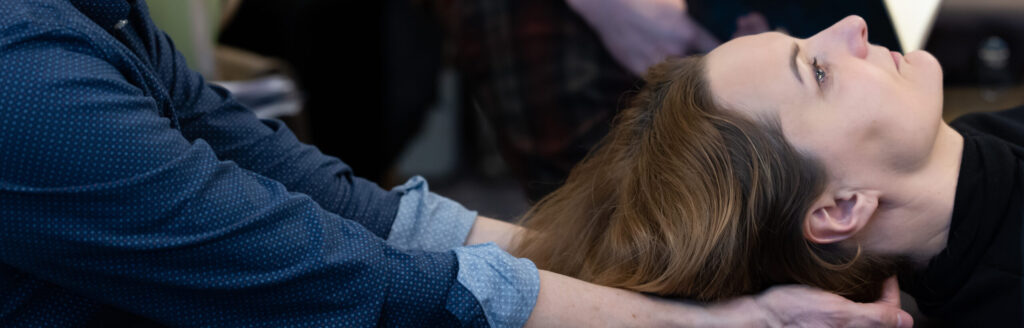
Gentle methods are most commonly used. The body’s own forces are employed, such as: positioning, breathing, tensing and relaxing. In addition, the therapist may apply passive forces at the limit of the range of motion, either in the direction of the movement restriction (a direct, mobilizing technique) or in the opposite direction (an indirect technique, which activates the body’s own regulatory mechanisms).
Treatment techniques can be divided into three levels (musculoskeletal, visceral, and cranial). However, techniques from more than one level are usually applied together. Osteopathic treatment is not the treatment of isolated symptoms, but the comprehensive treatment of the whole organism.